Table of Contents
Key Takeaways
- Park equipment like pull-up bars, parallel bars, and benches can replace gym machines for a full-body workout.
- Use 3–4 sets of 8–15 reps per exercise with 60–90 second rests to build strength and muscle.
- Incorporate unilateral movements like step-ups and Bulgarian split squats to correct imbalances.
- Progress by increasing reps, reducing rest, or adding carried weight (e.g., backpack) every two weeks.
- Always inspect equipment for safety and avoid training on wet or damaged surfaces.
Why Park Equipment Works for Full-Body Training
Public parks offer more than fresh air — they provide functional tools for a complete resistance workout. Pull-up bars, parallel bars, park benches, and low walls allow you to target every major muscle group without a gym membership. A 2021 study in the Journal of Strength and Conditioning Research found that bodyweight exercises on fixed bars produce similar muscle activation to machine-based training for the upper back and chest. By systematically using each piece of equipment, you can achieve progressive overload through angle changes, added reps, and reduced rest intervals.
Design your session around three movement categories: vertical pull (pull-ups), horizontal push (dips), and lower-body drive (step-ups or lunges). Aim for 3–4 sets of 8–15 reps per exercise, resting 60–90 seconds between sets. This structure keeps intensity high enough to stimulate muscle growth while avoiding excessive joint stress.
Upper Body: Pull-Up Bar and Parallel Bars
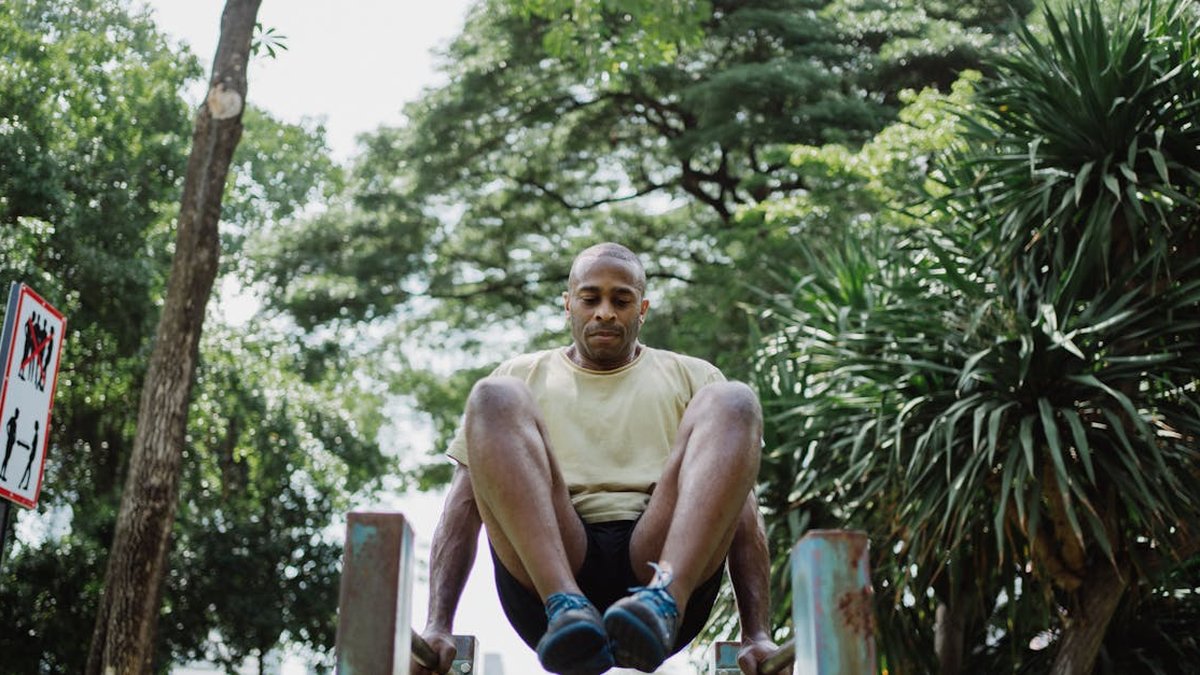
The pull-up bar is your primary tool for back and biceps. Perform standard pull-ups (palms facing away) at 3 sets of 8–12 reps. If you cannot complete 8 unassisted reps, use negative pull-ups: jump up and lower yourself over 5 seconds. For variety, add chin-ups (palms facing you) to shift emphasis to the biceps. For the parallel bars, execute dips at 3 sets of 10–15 reps. Keep your torso slightly forward and elbows tucked at 45 degrees to protect the shoulder joints. If dips are too difficult, perform bench dips on a park bench: place hands on the edge and lower your hips until elbows reach 90 degrees.
Progression tip: Increase difficulty by adding a 10-second hold at the top of each pull-up or by using a weight vest from home (5–10 kg). Track your max reps each week and add one rep per set when you reach the upper rep range.
Lower Body: Benches and Steps for Strength
Park benches serve as excellent platforms for step-ups and Bulgarian split squats. For step-ups, choose a bench 16–20 inches high. Perform 3 sets of 12–15 reps per leg, keeping your chest up and driving through the heel. For a more demanding variation, hold a backpack filled with books or water bottles (5–10 kg) to increase load. Bulgarian split squats require placing your rear foot on the bench and lowering your front knee to 90 degrees. Do 3 sets of 10–12 reps per leg. This unilateral movement corrects strength imbalances and activates the glutes and quads.
Sample lower-body block: 3 rounds of step-ups (12 reps each leg), bodyweight squats (20 reps), and walking lunges (10 reps per leg) with 60-second rest between rounds. This sequence builds endurance and strength without equipment.
Core and Stability: Using Walls and Ground
Park walls and grass provide stable surfaces for core work. Perform plank holds on the grass for 3 sets of 45–60 seconds. For an oblique challenge, add side planks: 3 sets of 30–45 seconds per side. To target the lower abs, do lying leg raises on a flat surface: 3 sets of 15–20 reps. For rotational strength, use a low wall (about knee height) for decline push-ups: place your feet on the wall and hands on the ground, then perform 3 sets of 10–15 reps. This variation increases upper chest and anterior deltoid activation by 20% compared to flat push-ups, according to a 2019 biomechanical analysis.
Most people ignore the park as a training tool because they think they need cables or machines. But a simple wall and a bench can give you a full-body stimulus that rivals any commercial gym.
Sample Full-Body Park Workout Routine
Use this 45-minute session to target all major muscle groups. Warm-up: 5 minutes of jogging, arm circles, and leg swings. Then complete the following circuit 3 times with 90-second rest between circuits:
- Pull-ups: 3 sets of 8–12 reps (or negatives if needed)
- Dips on parallel bars: 3 sets of 10–15 reps
- Step-ups on bench: 3 sets of 12 reps per leg
- Bulgarian split squats: 3 sets of 10 reps per leg
- Plank holds: 3 sets of 45 seconds
- Decline push-ups (feet on wall): 3 sets of 12–15 reps
Cool-down: 5 minutes of stretching for chest, lats, quads, and hamstrings. Hold each stretch for 30 seconds. Adjust reps downward if you cannot maintain proper form. Progress by reducing rest to 60 seconds or adding 2–5 kg of carried weight.
Progression and Safety Considerations
To continue making gains, increase your training volume by 10% every two weeks. For example, if you perform 30 total pull-up reps per session, aim for 33 reps after two weeks. Alternatively, decrease rest intervals from 90 seconds to 60 seconds, which increases metabolic stress and muscle endurance. Inspect park equipment before each use: check for rust, loose bolts, or splinters. Avoid wet bars during rain — they increase slip risk. If you experience wrist or shoulder pain, reduce range of motion or switch to easier variations (e.g., incline push-ups instead of decline).
Safety checklist: Use chalk or resin for grip if bars are smooth. Wear flat-soled shoes for stability on benches. Hydrate every 15 minutes, especially in warm weather. Stop immediately if you feel sharp joint pain — this indicates poor form or overuse.
Frequently Asked Questions
Common questions about bodyweight training
Can I build muscle with only park bodyweight exercises?
Yes, you can build significant muscle by progressively increasing reps, reducing rest, and using variations like negative pull-ups or weighted step-ups. A study in the Journal of Strength and Conditioning Research showed that bodyweight training on bars produces similar muscle activation to machine-based exercises.
How often should I train at the park for best results?
Train 3–4 times per week with at least 48 hours between sessions targeting the same muscle groups. This allows for adequate recovery and muscle adaptation.
What if I cannot do a single pull-up or dip?
Start with negatives: jump to the top of the pull-up position and lower yourself over 5 seconds. For dips, use a park bench for bench dips. Perform 3 sets of these easier variations and gradually increase the eccentric tempo.
Is it safe to use wet or rusty park equipment?
No. Wet surfaces increase slip risk, and rust can cause skin abrasions. Always choose dry, well-maintained equipment. If unsure, train on grassy areas for bodyweight squats, lunges, and planks instead.
Related Articles
Start Today
Park equipment provides a versatile, cost-free environment for full-body strength training. By using pull-up bars, parallel bars, benches, and walls, you can design a complete session that targets every major muscle group. Follow the sample routine, progress systematically with added reps or weight, and prioritize safety by checking equipment. This approach ensures consistent gains without a gym membership.