Table of Contents
- Why Low-Impact Cardio Matters for Joints
- Swimming: Full-Body Support with Zero Impact
- Stationary Cycling: Controlled Motion for Knees
- Elliptical Training: Smooth Stride Without Pounding
- Walking on Soft Surfaces: Simple and Effective
- Rowing Machine: Full-Body Cardio with Hip Hinge
- Structured Program: 4-Week Progression Plan
- Frequently Asked Questions
- Start Today
- Related Articles
Key Takeaways
- Low-impact cardio reduces joint stress while improving heart health and mobility.
- Swimming and stationary cycling are safest for knees and hips due to minimal impact.
- Elliptical training and walking on soft surfaces provide effective alternatives with proper form.
- Rowing offers full-body engagement but requires correct technique to protect the hips.
- A structured 4-week progression from 20 to 30 minutes per session builds endurance safely.
Why Low-Impact Cardio Matters for Joints
As we age, the cartilage in our knees and hips naturally thins, making high-impact activities like running or jumping more risky. Low-impact cardio provides the cardiovascular benefits without the repetitive pounding that accelerates joint wear. According to the American Academy of Orthopaedic Surgeons, adults over 60 should aim for at least 150 minutes of moderate-intensity low-impact aerobic activity per week. This protects joint structures while improving heart health, blood pressure, and metabolic function. For seniors with existing arthritis or joint replacements, choosing the right movement pattern is critical to maintaining mobility without pain.
Swimming: Full-Body Support with Zero Impact
Swimming eliminates gravitational stress on the knees and hips because water buoyancy supports up to 90% of body weight. A 30-minute moderate-paced freestyle swim burns approximately 250–350 calories for a 160-pound person while engaging the upper body, core, and legs. For those with hip arthritis, the breaststroke kick may aggravate the joint, so freestyle or backstroke with a flutter kick is recommended. Start with 3 sessions per week at 20 minutes each, then increase to 40 minutes over 4 weeks. Water temperature between 82°F and 86°F helps relax muscles and reduce joint stiffness.
Stationary Cycling: Controlled Motion for Knees
Stationary cycling places the knees in a closed-chain, non-weight-bearing position that strengthens the quadriceps and hamstrings without impact. Set the seat height so your knee has a 25- to 30-degree bend at the bottom of the pedal stroke—too low increases patellofemoral stress. Start with 15 minutes at a resistance that allows 60–70 RPM, then progress to 30–40 minutes at 70–80 RPM. A study in the Journal of Orthopaedic & Sports Physical Therapy found that 12 weeks of stationary cycling reduced knee pain by 38% in adults with osteoarthritis. Recumbent bikes offer additional back support for those with balance concerns.
Elliptical Training: Smooth Stride Without Pounding
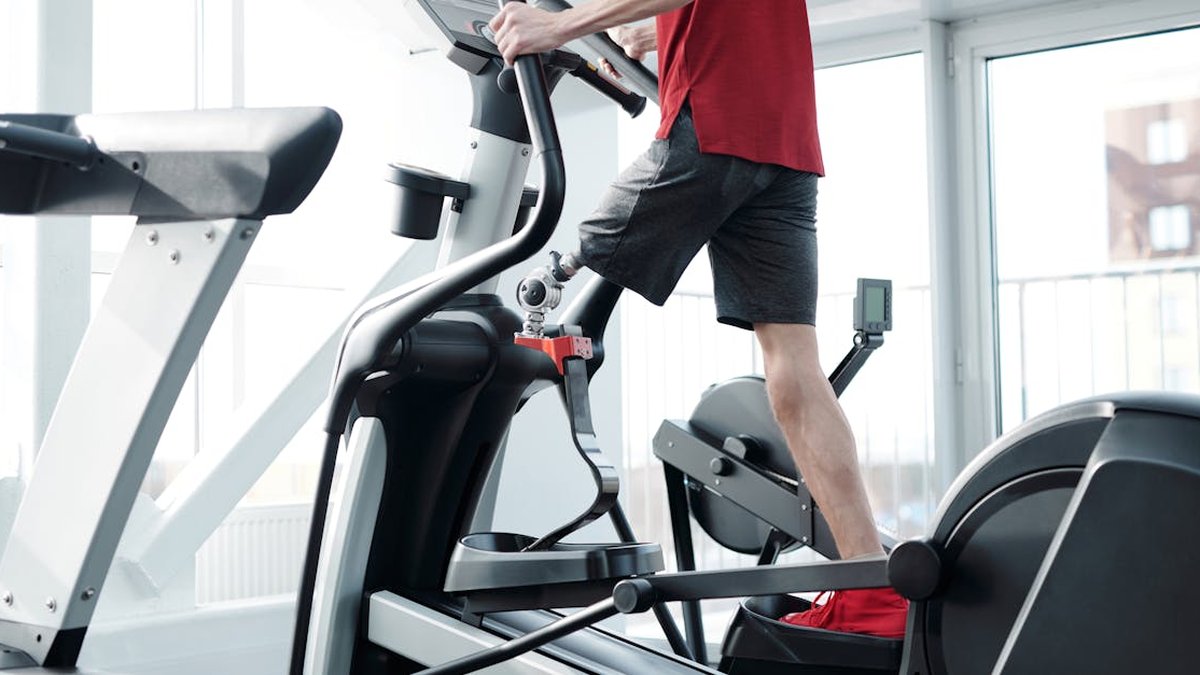
The elliptical trainer mimics walking or running but with feet remaining on pedals, eliminating the ground reaction force that stresses hips and knees. Set the incline to 0–2 for the first 2 weeks, then gradually increase to 4–6 to engage glutes without adding joint load. Use a stride length that feels natural—overstriding can strain the hip flexors. A 40-minute session at moderate effort (rate of perceived exertion 5–6 on a 10-point scale) burns about 300 calories. For extra hip stability, hold the moving handles lightly; avoid leaning on the stationary handles as that reduces core engagement and alters gait mechanics.
Walking on Soft Surfaces: Simple and Effective
Walking remains the most accessible low-impact cardio, but surface choice matters. Hard concrete transmits up to 3 times the body weight through the knees with each step, while grass, dirt trails, or rubberized tracks reduce impact by 30–50%. Walk at a brisk pace of 3.0–3.5 mph for 20–30 minutes daily. Use a mid-foot strike rather than heel strike to minimize shock transmission. For hip pain, walk on level ground and avoid hills until strength improves. Add 5 minutes of walking backward (on a flat, clear path) to strengthen the posterior chain and improve knee stability. Total weekly walking volume: 150 minutes minimum.
Rowing Machine: Full-Body Cardio with Hip Hinge
Rowing engages 85% of the body's muscles while the seat glides, keeping the hips and knees in a supported, fluid motion. Proper form is essential: drive with the legs first (60% of power), then lean back slightly (20%), and finally pull the handle to the lower ribs (20%). Set the damper setting to 3–5 (out of 10) for lower resistance and faster cadence—22–26 strokes per minute. Rowing at a steady pace for 20 minutes burns about 200 calories. Avoid rounding the lower back or pulling too early with the arms, as this increases shear force on the hips. For seniors with hip replacements, consult a physical therapist before starting rowing.
Structured Program: 4-Week Progression Plan
Combine the modalities above into a progressive weekly schedule. Week 1–2: 3 days per week, 20 minutes per session, alternating swimming and cycling. Week 3–4: 4 days per week, 30 minutes per session, add elliptical and walking on soft surfaces. Keep heart rate at 50–60% of maximum (roughly 220 minus your age) for the first 2 weeks, then progress to 60–70%. Include a 5-minute warm-up of slow movement and dynamic stretches (leg swings, ankle circles) and a 5-minute cool-down with static holds for 20 seconds each. Monitor joint pain: if any exercise increases pain by more than 2 points on a 0–10 scale, reduce duration by 5 minutes or switch modalities.
Low-impact cardio doesn't mean low results. With consistent, smart programming, seniors can maintain or even improve cardiovascular fitness while preserving joint health for decades.
Frequently Asked Questions
Common questions about senior fitness
Can I do low-impact cardio every day?
Yes, low-impact cardio is generally safe for daily activity, but listen to your joints. Alternate modalities (e.g., swimming one day, cycling the next) to avoid overusing the same muscle groups. Rest if you feel persistent joint soreness lasting more than 2 hours after exercise.
What is the best low-impact cardio for hip arthritis?
Swimming and stationary cycling are best because they are non-weight-bearing. Elliptical training with a low incline can also work if you avoid overstriding. Walking on a soft track may be tolerated if pain is mild.
How hard should I push myself during low-impact cardio?
Use the talk test: you should be able to speak in short sentences but not sing. For a more precise measure, aim for a rate of perceived exertion of 5–6 on a 10-point scale. Increase intensity only after 2 weeks of consistent training without joint pain.
Do I need special shoes for low-impact cardio?
Yes, supportive athletic shoes with good cushioning are important even for low-impact activities. For walking or elliptical use, choose shoes with a flexible sole and arch support. Replace them every 300–500 miles or when the tread wears unevenly.
Related Articles
Start Today
Protecting your knees and hips doesn't mean giving up effective cardio. By choosing low-impact options like swimming, stationary cycling, elliptical training, walking on soft surfaces, and rowing, you can maintain cardiovascular fitness, manage weight, and reduce joint pain. Start with short sessions, focus on proper form, and gradually increase duration and frequency. Consistency over intensity wins the long game for senior fitness.